The Zero-Click Era: How Do You Get Customers When Nobody Visits Your Website?
More than half of all Google searches now end without a single click. Discover how to get discovered and chosen across AI Overviews, social search, Reddit, and answer engines.

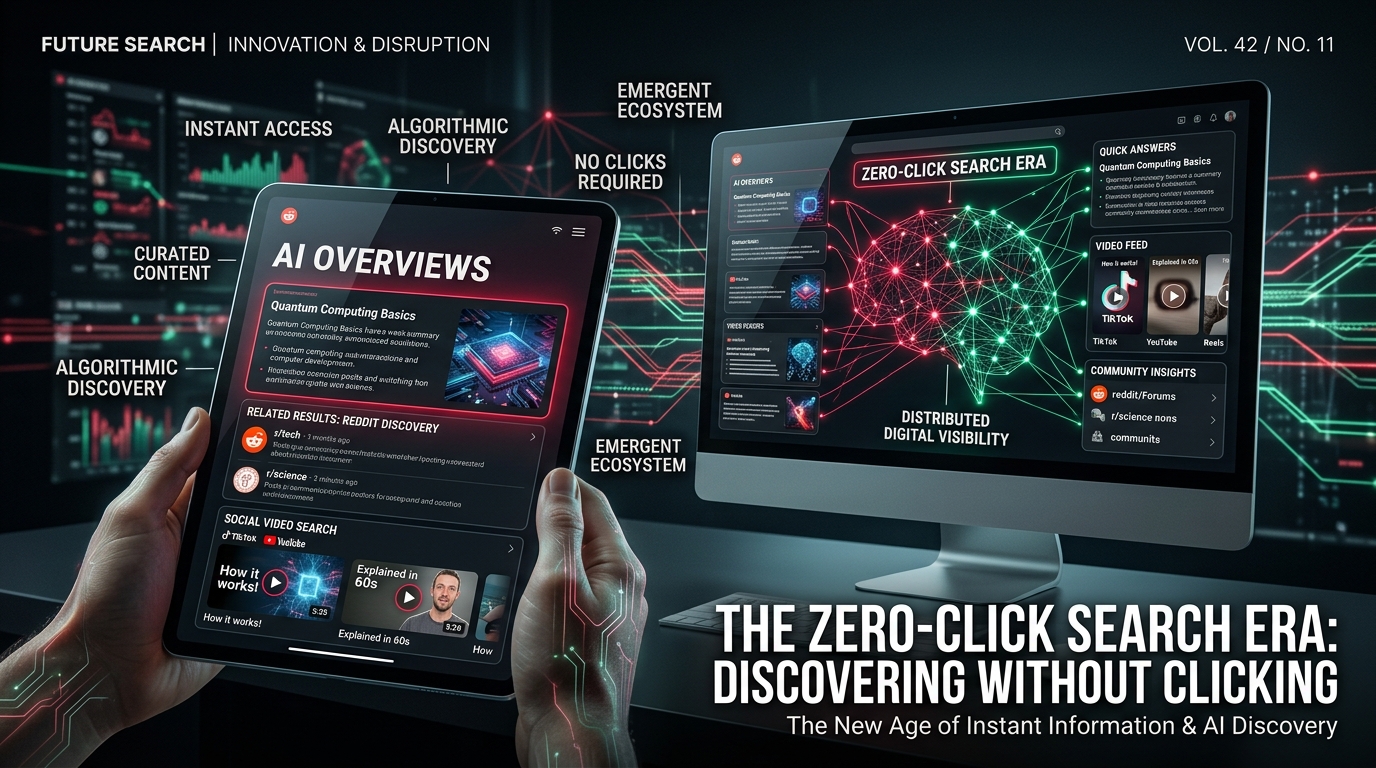
More than half of all Google searches now end without a single click to any website. The searcher gets their answer from an AI Overview, a featured snippet, or a knowledge panel — and moves on. For years, the entire marketing playbook was built on one assumption: rank well, get the click, convert the visitor. That assumption is breaking down.
This is not a temporary algorithm update. It is a structural shift in how people find information, driven by AI Overviews, social platforms doubling as search engines, and a new generation of "answer engines" like ChatGPT and Perplexity that summarize the web instead of linking to it. If your growth strategy still starts and ends with "get more website traffic," you are optimizing for a web that is disappearing.
Here is what is actually happening across search, social, and AI — and how to get discovered and chosen when nobody visits your website.
What Is the Zero-Click Era, and Why Is It Happening Now?
The "zero-click era" describes the growing share of searches and information-seeking behavior that never results in a visit to the source website. Instead, the answer is delivered directly inside the search results page, a social feed, a video, or a chatbot response.
Three forces are converging to drive this:
The common thread: the "answer" now travels to the user, instead of the user traveling to your website. Visibility has replaced traffic as the metric that matters first.
AI Overviews Are Eating Your Organic Traffic
Google's AI Overviews now appear on a large share of informational queries, placing an AI-generated summary — built from several sources — directly at the top of the results page. Studies across industries have shown click-through rates for the traditional #1 organic result drop significantly when an AI Overview is present, because the user's question is often already answered before they scroll further.
This does not mean SEO is dead. It means the goal of SEO has changed: instead of optimizing purely to rank #1 and earn the click, you now need to optimize to be the source the AI Overview cites and pulls from. Being cited inside the AI Overview — even without a click — builds brand recall and trust, and the clicks that do happen from AI Overviews tend to be higher-intent.
What actually improves your odds of being cited:
Social Search: Why People Are Googling on TikTok and Instagram
A significant share of younger users — Gen Z in particular — now default to TikTok or Instagram search bars for queries that used to go straight to Google: "best coffee shop near me," "is this skincare brand legit," "how to fix a leaking tap." Social platforms have become discovery-and-decision engines, not just entertainment feeds.
The reason is simple: social search returns real people, real reviews, and real footage instead of a wall of text. It feels more trustworthy and faster to scan. For brands, this means visibility now depends on being present and searchable inside these platforms, not just ranking on Google.
How to show up in social search:
Reddit Is the New Google — and Google Knows It
Google itself has quietly made Reddit one of the most visible domains in its results, especially for anything with the word "reddit" appended to a search ("best CRM for small business reddit"). Users trust Reddit because it reads as unfiltered, peer-to-peer opinion rather than marketing copy — and Google's ranking systems have adjusted to reward that perceived authenticity.
AI Overviews and answer engines also lean heavily on Reddit threads as source material, because forum discussions contain the kind of comparative, opinionated language ("X vs Y, which is actually better") that AI models are trained to summarize well.
What this means for your business:
YouTube: The Second-Largest Search Engine Nobody Optimizes For
YouTube processes billions of searches a month, yet most businesses treat it purely as a video hosting platform rather than a search engine in its own right. That is a missed opportunity — video is increasingly the preferred format for AI Overviews and answer engines when a query is best explained visually ("how to," "review," "comparison," "unboxing").
YouTube content also has a compounding advantage: a single well-optimized video can surface in Google search, YouTube search, AI Overviews, and social platforms (via Shorts/Reels repurposing) simultaneously.
Basics that still get overlooked:
Answer Engines and GEO: Optimizing for ChatGPT, Perplexity, and Beyond
Answer engines — ChatGPT, Perplexity, Google's Gemini, Claude, and similar tools — are becoming a real first step in the buyer journey, especially for research-heavy decisions like software purchases, service providers, and high-consideration products. Instead of "best project management tool," users now ask a conversational, specific question and expect a synthesized recommendation, often with sources cited.
This has given rise to GEO — Generative Engine Optimization — the discipline of optimizing content specifically to be retrieved, understood, and cited by AI models, as distinct from traditional SEO's focus on ranking in a list of links.
Core GEO principles:
So How Do You Actually Get Customers When Nobody Visits Your Website?
The zero-click era does not mean your website is irrelevant — it means your website is no longer the only place discovery and trust-building happen. The businesses winning right now treat visibility as a distributed asset, spread across every surface a potential customer might ask a question on.
In practice, that means shifting from a single-channel SEO strategy to a multi-surface visibility strategy:
Conversion still matters, but it increasingly happens through brand recall and trust built before the click — someone sees your brand mentioned across an AI Overview, a Reddit thread, and a YouTube review, and searches for you by name. That branded search is often the last visible touchpoint in a journey that started entirely off your website.
The New Visibility Checklist
Key Takeaways
The zero-click era rewards businesses that stop thinking in terms of "traffic" and start thinking in terms of "presence." Google's AI Overviews, social search on TikTok and Instagram, Reddit's rise as a trust layer, YouTube's role as a video-first search engine, and the growth of answer engines like ChatGPT and Perplexity are not separate trends — they are one shift: discovery has moved off the website and onto the surfaces where people already are.
Winning here requires an SEO and GEO strategy built for extraction and citation, not just ranking — content engineered to be found, quoted, and trusted wherever your customers are actually searching.
Ready to scale your digital presence?
Get a fixed-scope proposal for your web development, UX/UI design, or SEO project within 24 hours.
Start a project